Buy tabog.com ?
We are moving the project
tabog.com .
Are you interested in purchasing the domain
tabog.com ?
domain@kv-gmbh.de · 0541-91531010
Buy tabog.com ?
What was the compression pressure?
The compression pressure in an engine refers to the pressure created in the combustion chamber when the air-fuel mixture is compressed by the piston. This pressure is measured in pounds per square inch (psi) and is a critical factor in determining the engine's performance and efficiency. The compression pressure can vary depending on the engine design and specifications, but it is typically in the range of 120 to 180 psi for most gasoline engines. **
Why does pressure arise through compression?
Pressure arises through compression because when a substance is compressed, its molecules are forced closer together, leading to an increase in the number of collisions between the molecules. These collisions create a force that is exerted on the walls of the container, resulting in an increase in pressure. Additionally, as the volume of the substance decreases due to compression, the same amount of molecules now occupy a smaller space, leading to an increase in the density of the substance and therefore an increase in pressure. **
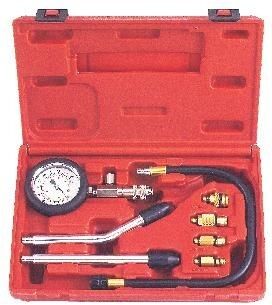
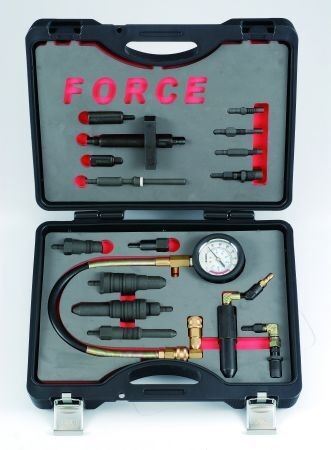
Similar search terms for FORCE-908G1-Compression-Pressure
Top-Angebote
Products related to FORCE-908G1-Compression-Pressure:
-
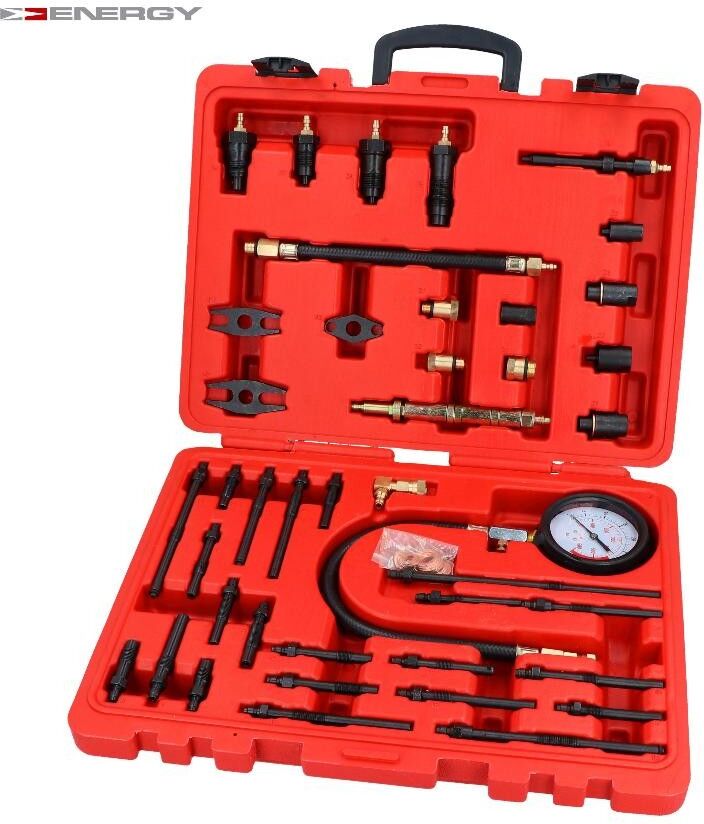
SEALEY CT951 Compression Pressure RecorderNumber of tools: 3; Packaging: Plastic Case; Number of manometers: 1; Number of adapters: 2; Hose Length [mm]: 320; Pressure [psi] from: 0; Pressure [psi] to: 300; Fuel Type: Petrol; Pressure from [kPA]: 0; Pressure to [kPA]: 2000; Gauge: with dial gauge; Quantity Unit: Set; Pipe length [mm]: 150; Manometer diameter [mm]: 65; Adapter enclosed: 14mm, 18mm; Scale: psi, kPa47,99 £*Shipping: 8,45 £Secure redirect to the provider


-
How do you calculate tension and compression force?
To calculate tension and compression forces in a structure, you need to consider the external loads acting on the structure and the internal forces within the members. Tension force is calculated by summing up all the external loads acting away from the structure, while compression force is calculated by summing up all the external loads acting towards the structure. Additionally, internal forces within the members, such as axial forces and bending moments, need to be analyzed to determine the distribution of tension and compression forces within the structure. This analysis is typically done using principles of statics and structural mechanics. **
-
'Pressure or Tensile Force?'
Pressure is a force applied perpendicular to the surface of an object, causing compression or squeezing. Tensile force, on the other hand, is a force applied to stretch or pull an object. The main difference between the two is the direction of the force applied - pressure is applied perpendicular to the surface, while tensile force is applied parallel to the surface. Both forces can cause deformation in materials, but in different ways. **
-
Pressure or tension force?
Pressure is a force exerted uniformly over a surface, while tension is a force that is transmitted through a rope, cable, or other similar objects. Pressure is typically measured in units of force per unit area, such as Pascals, while tension is measured in units of force. Both forces can cause deformation or changes in shape in an object, but pressure acts in all directions while tension acts along the direction of the object. **
-
How do you calculate the force of a compression spring?
To calculate the force of a compression spring, you can use Hooke's Law, which states that the force exerted by a spring is directly proportional to the displacement of the spring from its equilibrium position. The formula to calculate the force of a compression spring is F = kx, where F is the force, k is the spring constant, and x is the displacement of the spring from its equilibrium position. The spring constant can be determined by conducting a compression test on the spring and measuring the force applied and the resulting displacement. Once the spring constant is known, you can use it to calculate the force for any given displacement of the spring. **

What is the difference between effective piston force and pressure force?
Effective piston force is the force exerted by a piston on an object, taking into account factors such as friction and mechanical inefficiencies. Pressure force, on the other hand, is the force exerted by a fluid on a surface due to the pressure of the fluid. While pressure force is solely determined by the pressure of the fluid, effective piston force considers additional factors that may affect the actual force applied by the piston. **
How is pressure force transmitted through compressed air?
When air is compressed, the molecules are forced closer together, creating higher pressure. This pressure is transmitted through the air as the molecules collide with each other and with the walls of the container. When the compressed air is released, the pressure force is transmitted through the air as it expands and pushes against its surroundings. This can be harnessed for various applications, such as powering pneumatic tools or creating lift in aircraft. **
Top-Angebote
Products related to FORCE-908G1-Compression-Pressure:
-
FORCE 908G1 Compression Pressure RecorderNumber of tools: 8; Pressure [psi] from: 0; Pressure [psi] to: 300; Pressure from [bar]: 0; Pressure to [bar]: 20.6; Packaging: Plastic Case; Size: 10x1 mm, 12x1.25 mm, 14x1.25 mm, 18x1.5 mm; Weight [g]: 116055,99 £*Shipping: 8,45 £Secure redirect to the provider
-
What was the compression pressure?
The compression pressure in an engine refers to the pressure created in the combustion chamber when the air-fuel mixture is compressed by the piston. This pressure is measured in pounds per square inch (psi) and is a critical factor in determining the engine's performance and efficiency. The compression pressure can vary depending on the engine design and specifications, but it is typically in the range of 120 to 180 psi for most gasoline engines. **
-
Why does pressure arise through compression?
Pressure arises through compression because when a substance is compressed, its molecules are forced closer together, leading to an increase in the number of collisions between the molecules. These collisions create a force that is exerted on the walls of the container, resulting in an increase in pressure. Additionally, as the volume of the substance decreases due to compression, the same amount of molecules now occupy a smaller space, leading to an increase in the density of the substance and therefore an increase in pressure. **
-
How do you calculate tension and compression force?
To calculate tension and compression forces in a structure, you need to consider the external loads acting on the structure and the internal forces within the members. Tension force is calculated by summing up all the external loads acting away from the structure, while compression force is calculated by summing up all the external loads acting towards the structure. Additionally, internal forces within the members, such as axial forces and bending moments, need to be analyzed to determine the distribution of tension and compression forces within the structure. This analysis is typically done using principles of statics and structural mechanics. **
-
'Pressure or Tensile Force?'
Pressure is a force applied perpendicular to the surface of an object, causing compression or squeezing. Tensile force, on the other hand, is a force applied to stretch or pull an object. The main difference between the two is the direction of the force applied - pressure is applied perpendicular to the surface, while tensile force is applied parallel to the surface. Both forces can cause deformation in materials, but in different ways. **
Similar search terms for FORCE-908G1-Compression-Pressure
-
SEALEY CT951 Compression Pressure RecorderNumber of tools: 3; Packaging: Plastic Case; Number of manometers: 1; Number of adapters: 2; Hose Length [mm]: 320; Pressure [psi] from: 0; Pressure [psi] to: 300; Fuel Type: Petrol; Pressure from [kPA]: 0; Pressure to [kPA]: 2000; Gauge: with dial gauge; Quantity Unit: Set; Pipe length [mm]: 150; Manometer diameter [mm]: 65; Adapter enclosed: 14mm, 18mm; Scale: psi, kPa47,99 £*Shipping: 8,45 £Secure redirect to the provider
-
Pressure or tension force?
Pressure is a force exerted uniformly over a surface, while tension is a force that is transmitted through a rope, cable, or other similar objects. Pressure is typically measured in units of force per unit area, such as Pascals, while tension is measured in units of force. Both forces can cause deformation or changes in shape in an object, but pressure acts in all directions while tension acts along the direction of the object. **
-
How do you calculate the force of a compression spring?
To calculate the force of a compression spring, you can use Hooke's Law, which states that the force exerted by a spring is directly proportional to the displacement of the spring from its equilibrium position. The formula to calculate the force of a compression spring is F = kx, where F is the force, k is the spring constant, and x is the displacement of the spring from its equilibrium position. The spring constant can be determined by conducting a compression test on the spring and measuring the force applied and the resulting displacement. Once the spring constant is known, you can use it to calculate the force for any given displacement of the spring. **
-
What is the difference between effective piston force and pressure force?
Effective piston force is the force exerted by a piston on an object, taking into account factors such as friction and mechanical inefficiencies. Pressure force, on the other hand, is the force exerted by a fluid on a surface due to the pressure of the fluid. While pressure force is solely determined by the pressure of the fluid, effective piston force considers additional factors that may affect the actual force applied by the piston. **
-
How is pressure force transmitted through compressed air?
When air is compressed, the molecules are forced closer together, creating higher pressure. This pressure is transmitted through the air as the molecules collide with each other and with the walls of the container. When the compressed air is released, the pressure force is transmitted through the air as it expands and pushes against its surroundings. This can be harnessed for various applications, such as powering pneumatic tools or creating lift in aircraft. **
* All prices are inclusive of VAT and, if applicable, plus shipping costs. The offer information is based on the details provided by the respective shop and is updated through automated processes. Real-time updates do not occur, so deviations can occur in individual cases. ** Note: Parts of this content were created by AI.